Angioplasty is a minimally invasive medical technique that improves blood flow and lowers the risk of heart attacks by opening constricted or blocked arteries in the heart. Dr. Ravinder Singh Rao guide on angioplasty provides a comprehensive and easy-to-understand explanation of this life-saving treatment. He goes through the process step-by-step, using his vast knowledge in interventional cardiology to show how a balloon catheter is used to widen the artery and how stents may be inserted to keep it open. In order to preserve long-term heart health, his guidance also stresses preparation prior to the procedure, what to anticipate throughout recovery, and significant lifestyle adjustments. By presenting complex medical information in a simple and practical way, Dr. Ravinder Singh Rao helps patients approach angioplasty with confidence and awareness.
What is Angioplasty?
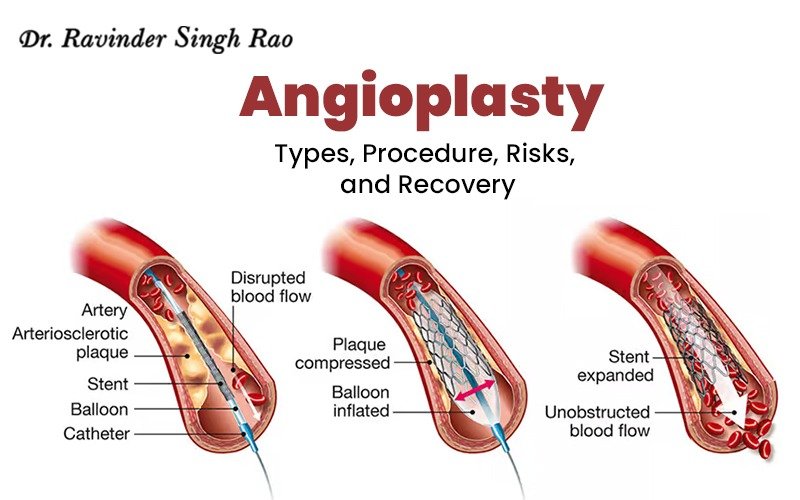
The terms “angi” (blood vessel) and “plasty” (opening) combine to form the phrase “angioplasty.” Angioplasty is a surgical technique that opens a constricted or obstructed artery close to the heart. For narrowed or congested arteries, it is a common treatment. Angioplasty and percutaneous coronary intervention, or PCI, are often used interchangeably. A little balloon is used by a medical professional to press plaque against the artery walls during an angioplasty procedure, allowing blood to pass through your artery without restriction. To keep the newly opened space open, they frequently place a stent or tube inside.
Types of Angioplasty
Angioplasty falls into one of two main categories:
- Balloon angioplasty is a procedure that removes plaque from an artery by applying pressure produced by an inflated balloon. When a stent cannot be positioned in the intended area, it is the sole choice.
- The process of placing a stent entails putting a wire mesh tube into the artery. Stents can be used to stop the artery from narrowing again following an angioplasty treatment.
What Does Angioplasty Treat?
Angioplasty is a useful treatment for atherosclerosis, which is an accumulation of plaque made of fat and cholesterol in different areas of your body’s arteries.
- Coronary Artery Diseases: Angioplasty, also known as percutaneous coronary intervention, is advantageous for a healthy heart since a small or clogged coronary artery can prevent your heart from getting the oxygen it needs, causing chest pain and/or a heart attack.
- Peripheral Artery Diseases: Atherosclerosis in the main arteries of the arms, legs, and pelvis can be treated using angioplasty.
- Carotid Artery Diseases: Angioplasty is a treatment for a blocked artery in the neck. They may worsen to the point that your brain doesn’t get enough oxygen to operate properly if treatment is not received.
- Chronic Kidney Diseases: The amount of oxygen that can reach your kidneys is impacted by plaque accumulation in the arteries. In some cases, to address the issue, renal artery angioplasty might be required.
Angioplasty Procedure
A medical professional will clean and numb the area of the body—typically the groin, but occasionally the wrist—where the catheter will be put before starting angioplasty. In the next step, using X-rays as a guide, a physician inserts a catheter into the artery and guides it toward the coronary artery. In order to identify cardiac blockages, the physician injects a contrast dye into the artery once the catheter is inserted. After a thorough examination, the doctor inserts a guidewire and another catheter, usually with a balloon at its tip.
Next, by inflating the balloon, the physician opens the artery by pushing the plaque buildup aside. The artery may be kept open with the use of a stent. Angioplasty can take several hours depending on the difficulty, several blockages, and complications.
Who Needs to Have Angioplasty?
Patients who have experienced a heart attack or coronary artery disease undergo angioplasties. To clear obstructed arteries, angioplasty is also performed in the neck, arms, legs, kidneys, and pelvis. Angioplasty enhances blood flow to the organ the artery serves by widening a plaque-clogged artery.
Risks or Complications of Angioplasty
All invasive treatments include some risk, even if major angioplasty complications are uncommon. For instance, an emergency coronary artery bypass graft can be necessary following an angioplasty. Approximately one out of every 100 surgeries results in complications, though this figure may fluctuate. Other risks associated with angioplasty include:
- Coronary artery disease
- A dye reaction
- Blood clot
- An abnormal heartbeat
- Stroke
- Bleeding
- Chest discomfort
- Damage to the blood vessels of the kidney
- A re-blockage if no stent is implanted
Angioplasty Risk Age
Patients over 60 and those with many blocked arteries, renal disease, heart failure, and other conditions are at a higher risk of angioplasty complications.
Are There Any Side Effects of Angioplasty?
Heart artery damage, infection, bleeding or bruising at the catheter site, allergic reaction to the dye or contrast, kidney damage, blood clots resulting in stroke or heart attack, and abdominal hemorrhage (retroperitoneal bleeding) are some of the complications associated with angioplasty.
Diet After Angioplasty
Consider using these items in your everyday diet planning as you recuperate from angioplasty:
- Healthy oils
- Fruits & vegetables
- Whole grains
- Nuts
- Freshly brewed tea
- Sprouts or legumes
- Dark chocolate
FAQs
What is Angioplasty?
Angioplasty is a procedure to open blocked or narrowed heart arteries to improve blood flow.
Why is angioplasty done?
It is used to treat coronary artery disease-related clogged arteries, heart attacks, and chest pain.
How is angioplasty performed?
The blocked artery is widened by inserting a balloon catheter and inflating it; a stent is frequently put to maintain the artery open.
Is angioplasty safe?
Yes, although there are some dangers associated with any surgery, including bleeding, infection, and artery damage, it is normally safe.
How long does recovery take?
The majority of patients recover in a few days to a week, while complete improvement in heart health may take longer.