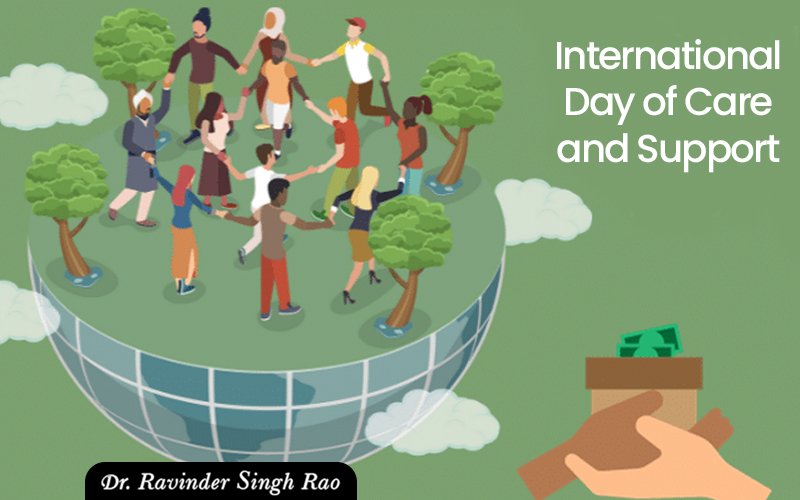
The United Nations adopted a resolution designating October 29 as the International Day of Care and Support annually in an effort to establish a system of care and support for all caregivers, whether they are paid or not. The system would guarantee complete adherence to human rights within a strong and resilient framework that is inclusive of people with disabilities, age-sensitive, and gender-responsive. It emphasizes dispersing, cutting, appreciating, and—above all—acknowledging unpaid care, domestic labor, and assistance. Around 380 million people are employed in the care industry. Due to low pay and unfavorable working circumstances, there is a scarcity of care workers as a result of urbanization, migration, nuclear families, and the rise in the number of women in the workforce. The likelihood of a care crisis is extremely high.
On the occasion of the International Day of Care and Support 2024, we recognize the invaluable contributions of Dr. Ravinder Singh Rao, a leading cardiologist dedicated to advancing heart health and patient care. He emphasizes the value of comprehensive care and support for patients and their families, drawing on his years of experience in the diagnosis and treatment of cardiovascular illnesses.
In addition to meeting physical demands, his holistic approach promotes mental health and guarantees that each patient receives individualized advice throughout the course of therapy. As a passionate adviser for heart health awareness, Dr. Ravinder Singh Rao encourages individuals to prioritize regular check-ups, healthy lifestyles, and open communication with healthcare providers.
Heart Specialist – TAVI and TAVR
Why was an International Day of Care and Support Established?
Everybody needs help and care at some point in their lives. According to UN Women and ECLAC (2020), care includes a range of routine activities that support life. This includes running the home, attending to medical requirements, educating the family, regulating social interactions, and offering psychological support. The United Nations General Assembly granted approval on July 24, 2023, to 13 nations’ proposal to formally create the International Day of Care and Support, which will be observed on October 29 each year.
This milestone contributes to ending the invisibility of essential work that benefits individuals, families, and communities. The national, regional, and international economies all heavily rely on care work. The economic worth of hours spent providing unpaid care is thought to be equivalent to 9% of the world’s gross domestic product. This amounts to $11 trillion annually. This percentage is equivalent to 15% of GDP in OECD nations. Depending on the nation, the International Labor Organization estimates that the value of care accounts for anywhere from 10% to 39% of GDP. In Mexico, this figure reached 24.7% of GDP in 2021, with 18% contributed by women.
The Theme for International Day of Care and Support 2024
The theme for the International Day of Care and Support in 2024 is “Ageing with Dignity: The Importance of Strengthening Care and Support Systems for Older Persons Worldwide.”
History of International Day of Care and Support
By adopting resolution A/RES/77/317, the UN General Assembly declared October 29 to be the International Day of Care and Support. The resolution’s adoption acknowledged the value of care and support in promoting healthy aging, increasing gender equality, and guaranteeing the long-term viability of our economies and society. In addition to observing the International Day every year, the resolution urges Member States, the UN system, civil society, the commercial sector, academia, and the general public to increase awareness of the value of care and support and the necessity of making investments in a resilient and inclusive care economy.
Significance of International Day of Care and Support
Support and care work is vital to our economy and societies. It encompasses a variety of tasks, ranging from unpaid caregiving by friends and family to paid caregiving by qualified caregivers. People of all ages including children, the elderly, those with disabilities, and those who are ill or injured, depend on care and support workers to offer those vital services. An opportunity to honor and celebrate the efforts of care and support workers as well as to promote laws and funding that promote a robust and inclusive care economy is provided by the International Day of Care and Support.
How to Observe the International Day of Care and Support
The International Day of Care and Support can be observed in a variety of ways. Here are a few ideas:
- Support organizations about the importance of care and support and the challenges faced by care workers.
- Find out more about the difficulties experienced by carers and the value of assistance and care.
- Raise awareness of the need for investments and policies that promote a resilient and inclusive care economy.
- Show your appreciation for the care and support workers in your life.
Why Celebrate the International Day of Care and Support?
On this global day of celebration, unpaid carers and those who assist them have the chance to ensure that their voices are heard. Even though giving care has many priceless advantages, doing so unpaid can have a negative effect on a carer’s health and well-being as well as their financial situation if they must take time from work to care for a loved one. The United Nations declared October 29th to be the International Day of Care and Support in an effort to acknowledge, decrease, value, and redistribute unpaid care as well as to acknowledge and value paid care labor and care workers.
FAQ's
What is the International Day of Care and Support?
It is a worldwide celebration that brings attention to the value of helping those in need, including the aged, the ill, and the vulnerable.
What is the Theme for International Day of Care and Support 2024?
The theme for the International Day of Care and Support in 2024 is “Ageing with Dignity: The Importance of Strengthening Care and Support Systems for Older Persons Worldwide.”
Why is this day important?
It emphasizes how important support networks and caregivers are to improving people’s and communities’ well-being.
How can I get involved?
You can get involved by volunteering, giving to care organizations, spreading awareness, or just being kind and caring to people who are less fortunate.
Who should participate in this day?
Everyone, including healthcare providers, organizations, caregivers, and individuals, can contribute to promoting care and support.