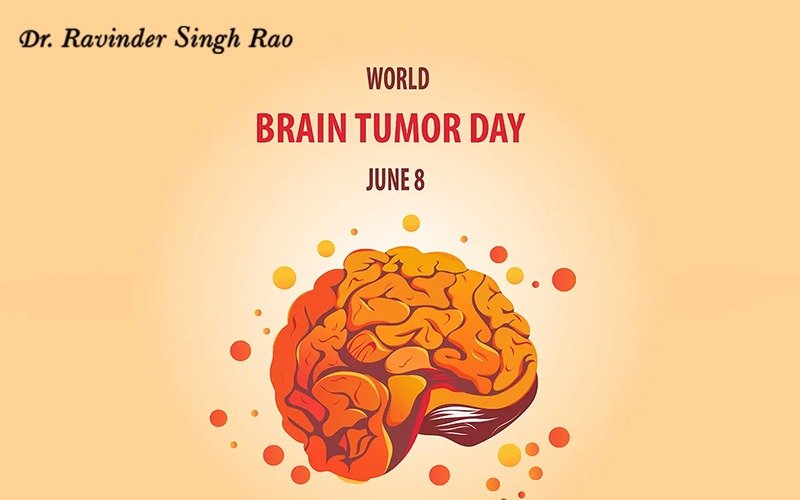
We observe World Brain Tumor Day on June 8th each year to spread knowledge and awareness of brain tumors. This significant World Brain Tumor Day also honors people impacted by brain tumors. The German Brain Tumor Association, a nonprofit organization with headquarters in Leipzig, made the initial observation of it in 2000. A brain tumor develops when brain cells begin to grow abnormally quickly, creating a mass of aberrant brain cells. The symptoms appear as these aberrant cells begin to shut the small contained space inside the skull.
On World Brain Tumor Day 2026, Dr. Ravinder Singh Rao emphasizes the importance of early diagnosis, awareness, and timely treatment for brain tumors. He recommends individuals to be aware of signs, including chronic headaches, vision issues, memory loss, and abrupt neurological changes, because prompt medical attention can have a big impact on recovery and treatment results. Dr. Ravinder Singh Rao wants to help patients and their families on their journey by raising awareness and providing appropriate guidance. She also wants to share the message that positive care and high-quality healthcare may help fight brain tumors with confidence.
History of World Brain Tumor Day
The ancient medical literature does not describe brain tumors, but they frequently discuss skull trepanation—a surgically performed burr hole in the human skull—as a treatment for brain tumor symptoms. In their treatises, philosophers such as Socrates, Celsus, Galen, and Hippocrates discuss trepanation as a way to reduce intracranial pressure, but they do not address brain tumors. In antiquity, after a protracted struggle with symptoms like headaches, convulsions, and unconsciousness, brain tumors ultimately led to death.
Many neurosurgeons began to identify and diagnose brain cancers when X-rays were discovered in 1895. Fedor Krause, a German neurosurgeon, located brain malignancies using X-rays. Later in 1954, a nuclear scanner was used for the first time to locate brain tumors noninvasively. Sir Godfrey N. Hounsfield developed the first C.T. scanner several decades later. C.T. scanners were first introduced in the United States and London, England, in 1971. Full-body CT scanners were first available in 1975.
World Brain Tumor Day Timeline
- 1895 (X-Rays are Discovered):- Fedor Krause uses X-rays to identify and locate brain cancers.
- 1918-1919 (Pneumoencephalograph Procedure is Conducted):- Pneumoencephalography, which has a 73% accuracy rate, was created after neurosurgeon Walter E. Dandy saw that free intraperitoneal air outlines the abdominal organs and applied the same theory to the brain.
- 1971 (C.T. Scanners are Installed):- Sir Godfrey N. Hounsfield, an engineer, developed the first CT scanner, which became one of the most accurate and revolutionary diagnostic imaging technologies in medical history.
- 1985 (Contrasting Agent with M.R. Imaging is Essential:- The administration of contrast agents is crucial for the representation of intracerebral metastases, as demonstrated by EJ Russell in his publication “Multiple cerebral metastases: detectability with Gd-DTPA-enhanced MR imaging.”
How to Observe World Brain Tumor Day
- Host a Community Event:- Organize neighborhood gatherings and begin charitable fundraising. Organize a variety of events to raise money, such as game shows, music performances, or bake sales.
- Spread Awareness:- To spread awareness about brain tumors, wear a gray ribbon. To increase awareness and explain the early signs and symptoms, host an engaging session for local residents.
- Volunteer:- Investigate the cause of brain cancers using N.G.Os. Invest as much time, money, and effort as you can while working for a worthy cause.
5 Facts About Brain Tumors
- Symptoms of a brain tumor are not Obvious:- Brain tumors typically cause headaches and nausea.
- 29% Cases of Brain Tumors are Malignant:- Approximately 700,000 Americans have a primary brain tumor, of which 71% are benign.
- It can occur at any Age:- At any age, brain tumors can occur, but it is mostly observed in young children and older adults.
- It is the Eighth Most Common Cancer:- Among people over 40, brain tumors rank as the eighth most prevalent type of cancer.
- Survival Rates Might Vary:- Numerous factors, such as age, ethnicity, and even the time it takes to identify it, affect survival rates.
Why World Brain Tumor Day is Important
- It raises awareness about brain tumors:- People are still unaware of the symptoms of brain tumors and even how to treat them, making them a growing health risk. Brain Tumor Day promulgates information to the masses.
- It brings people together:- On World Tumor Day, the public unites to offer all assistance they can to those battling brain tumors. For patients, it fosters a supportive and upbeat atmosphere.
- It brings financial assistance to patients:- On World Brain Tumor Day, people volunteer and organize a variety of activities, including fundraisers. This is the ideal day to assist patients in any manner you can.
FAQs
What is World Brain Tumor Day?
Every year on June 8, people mark World Brain Tumor Day to raise awareness of brain tumors, assist patients and caregivers, and promote early diagnosis and treatment.
Why is World Brain Tumor Day important?
This day supports persons who are impacted by brain tumors while educating the public about their symptoms, available treatments, and the value of prompt medical care.
What is a brain tumor?
An abnormal cell growth in or around the brain is called a brain tumor. It may be malignant (cancerous) or benign (not cancerous).
What are the common symptoms of a brain tumor?
Common symptoms may include vision problems, persistent headaches, memory issues, seizures, nausea, balance difficulties, and changes in speech or behavior.
What causes brain tumors?
Although the precise reason is frequently unknown, radiation exposure, certain medical problems, and hereditary factors may raise the risk.