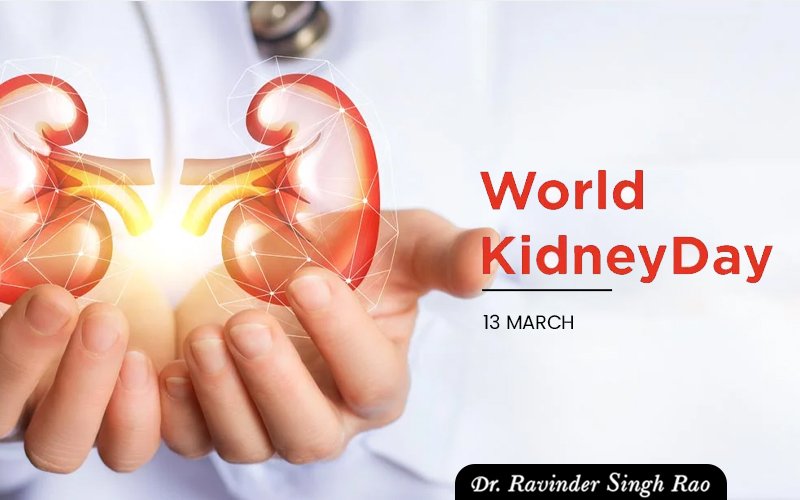
World Kidney Day is an awareness day that raises awareness of the significance of kidney health worldwide. It is observed annually on the second Thursday of the 13th of March. The purpose of the day is to bring attention to the risk factors for chronic kidney disease (CKD). In addition, one of the main goals of World Kidney Day is to educate individuals about the management of CKD and to motivate people to consider kidney transplants and donation as an effective way to assist those with Kidney failure. The International Federation of Kidney Foundations (IFKF) and the International Society of Nephrology (ISN) collaborated to create the observance in 2006.
On World Kidney Day, Dr. Ravinder Singh Rao, a renowned cardiologist highlights the crucial connection between Kidney and heart health. He emphasizes that early detection and prevention are crucial as kidney disorders frequently go undetected until they have world kidney progressed to an advanced stage. Dr. Ravinder Singh Rao advises maintaining a heart-healthy lifestyle, as high blood pressure, cardiovascular diseases, and diabetes, are major risk factors for kidney failure. He emphasizes the value of routine tests, a healthy diet, drinking plenty of water, and leading an active lifestyle in order to maintain kidney and heart health.
Heart Doctor, TAVI Surgery, TAVI Procedure, Best Cardiologist, TAVI Cardiologist In India, TAVR Cardiologist in India
The Theme for World Kidney Day 2025
The theme for World Kidney Day 2025 is “Are Your Kidneys OK? Detect Early, Protect Kidney Health”.
History of World Kidney Day
The existence of kidneys in the human body was known to civilizations long before science attained its current level of advancement. This explains the more than thirty references to kidneys in the Holy Bible. According to Professor Garabed Eknoyan, the organ represents emotions, wisdom, and desire. An old description of the kidneys can be found in the Egyptian Ebers Papyrus. This originates in 1550 B.C. and was discovered by the German Egyptologist Georg Ebers. Ancient physicians’ observations are included in this text, making it significant. Unexpectedly, it also features pictures of human mummies with ailments like kidney stones and cysts.
Given how crucial the kidneys are to the body’s proper operation, it makes sense that they were discovered at such a young age. To raise awareness about the benefits of kidneys, World Kidney Day was established in 2006. The International Federation of Kidney Foundations (IFKF) and the International Society of Nephrology (ISN) worked together to establish the day, which acts as a global awareness campaign on the significance of kidney health. This day also emphasizes the prevalence of kidney diseases and the importance of maintaining optimal kidney health. The day’s other objectives include highlighting the significance of high blood pressure and diabetes as risk factors for chronic kidney disease (CKD) and encouraging routine C.K.D. screening for all patients with these conditions.
Timeline of World Kidney Day
- 1902 (A Kidney Transplant on a Dog): The Vienna Medical School in Austria performs the first kidney transplant on a dog.
- 1936 (An Unsuccessful Transplant): The first unsuccessful human-to-human kidney transplant takes place).
- 1954 (Human Kidney Transplant): At the Peter Bent Brigham Hospital in Boston, Massachusetts, similar twin boys got the first successful live donor human kidney transplant; the transplanted kidney functioned well for eight years.
- 1962 (The First Successful Transplant): In Boston, the kidney lasted 21 months after the first successful kidney transplant from a deceased donor. This is also the first time a drug called , a novel immunosuppressive medication, has been administered.
- 1968 (The Uniform Donor Card is Created): Anyone who is 18 years of age or older may lawfully donate their own organs when they pass away in the US due to the Uniform Donor Card, which was established under the Uniform Anatomical Gift Act.
How to Observe World Kidney Day
- Get a Check-up: Until it’s too late, what’s going on inside your body it’s impossible to know. Learn more about your kidney health on this day, get a checkup.
- Spread Awareness: The main aim of World Kidney Day is to increase regarding kidney disease and health. So do your part and spread the message.
- Share Your Experience: Have you ever suffered from a kidney problem? Do you know someone who has experienced kidney problems? If so, share the stories on social media so individuals know what to look out for.
5 Interesting Facts About Kidney
- Size: The kidneys weigh between four and six ounces and are roughly the size of a cell phone.
- Creating Vitamins: Kidneys are capable of generating Vitamin D in the body.
- The Impact of Losing a Kidney: The body only loses about 25% of kidney functioning, if one of the kidneys is removed from the body.
- The Largest Kidney Stone Recorded: At its widest point, the largest kidney stone measured 4.66 inches in diameter and weighed 12.5 ounces.
- Kidney Filtration: Every 30 minutes, all the blood in your body goes through your kidneys and is filtered.
Heart Specialist Doctor in Jaipur, Top Cardiologist in Jaipur, Heart Valves Expert, Heart Attack Treatment in Jaipur, Best Cardiologist Expert in India, Heart Bypass Surgeon, Angioplasty Expert in Delhi, Heart Disease Expert in Kolkata, Heart Attack Treatment in Kolkata, Heart Expert Doctor in Nagpur, Best Cardiologist in Chandigarh, Heart Valve Expert in Hyderabad, TAVR Expert in Hyderabad, Rotablation Angioplasty Expert in Delhi.
FAQs
What is World Kidney Day and why is it important?
Every year, World Kidney Day serves as a global awareness campaign to inform people about kidney health, the value of early identification, and ways to avoid renal disease. It aims to reduce the impact of kidney-related conditions worldwide.
When is World Kidney Day observed?
Every year on the second Thursday in March, we celebrate World Kidney Day. It will fall on March 13 in 2025.
Why is Kidney health important?
The kidneys are essential for blood pressure regulation, fluid balance, and waste filtering. Chronic kidney disease (CKD) can result from poor kidney health and, if left untreated, may require treatment or a kidney transplant.
What are the common risk factors for kidney disease?
The main risk factors include high blood pressure, diabetes, smoking, obesity, a family history of kidney disease, and excessive use of painkillers or alcohol.
How can I keep my Kidney healthy?
Eat a healthy, balanced diet, drink plenty of water, exercise frequently, regulate blood pressure and blood sugar, abstain from smoking and excessive drinking, and get regular kidney function testing.