A Significant Development in Structural Heart Care
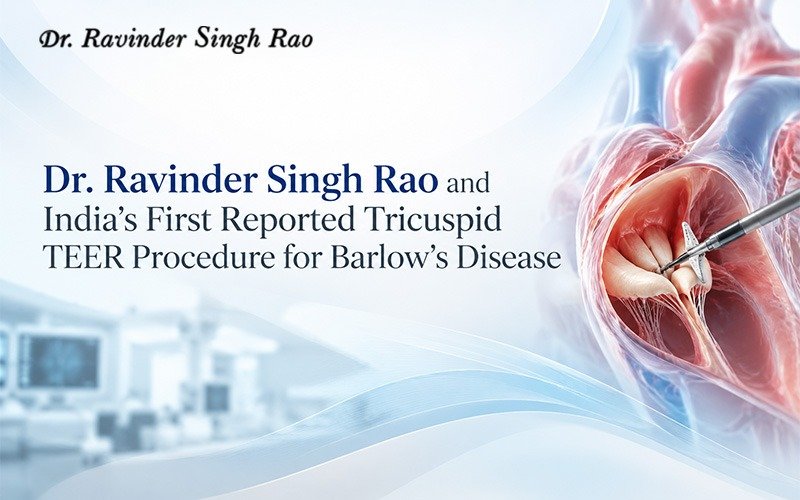
Patients with complicated heart valve issues now have more options because of developments in interventional cardiology. A significant medical development has recently emerged from Jaipur, where Dr. Ravinder Singh Rao, an interventional structural cardiologist, was part of the medical team that successfully treated an elderly patient with a rare tricuspid valve disorder without the need for open-heart surgery. India, 24 September 2026: A specialized tricuspid TEER (Transcatheter Edge-to-Edge Repair) device has effectively treated an older patient with rare Tricuspid Valve Barlow’s Disease, a disorder that caused considerable leakage of the heart’s tricuspid valve, without requiring open-heart surgery.
This medical milestone is said to be the first instance of Tricuspid TEER being utilized to treat primary tricuspid regurgitation brought on by tricuspid valve prolapse linked to Barlow’s disease in the nation.
Who is Dr. Ravinder Singh Rao?
Dr. Ravinder Singh Rao is an interventional structural cardiologist who specializes in treating structural heart disorders via sophisticated catheterization. In this reported case, he worked alongside Dr. Kalash Chandra, Dr. Prashant Varshney, and their medical team. Prior to the treatment, rigorous preparation and a thorough evaluation of the patient’s atypical valve architecture were necessary. Dr. Ravinder Singh Rao emphasized that accurate diagnosis and treatment are crucial since tricuspid valve illnesses can be especially difficult when the valve anatomy is complicated.
Understanding Tricuspid Valve Barlow’s Disease
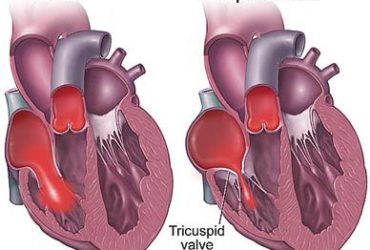
Abnormal valve tissue, which can thicken, expand, and become abnormally flexible, is linked to Barlow’s disease. This can cause the valve leaflets to bulge or prolapse, preventing them from closing properly. Blood may flow backward during each heartbeat if the tricuspid valve fails to seal properly. Tricuspid regurgitation (TR) is the term for this condition.
In severe cases, tricuspid regurgitation can be associated with symptoms such as fatigue, swelling of the legs and abdomen, reduced appetite, and fluid accumulation. The liver and kidneys are among the other organs that may be impacted by persistent, severe leaking.
What Made This Case Different?
According to reports, the patient had been having symptoms for around half a year. Significant backward blood leakage through the valve was induced by severe tricuspid regurgitation brought on by the underlying Barlow’s disease. Instead of conventional open-heart surgery, the medical team used a catheter-based Tricuspid TEER procedure.
The heart was reached by inserting a tiny catheter through a blood vessel. The physicians identified the prolapsing tissue and saw the aberrant valve structure using sophisticated 3-D echocardiography. Two clips from a dedicated tricuspid TEER device were then placed to bring the valve leaflets closer together and improve their ability to close.
Reported Outcome of the Tricuspid Procedure
The treatment team reported that the procedure decreased valve leakage by over 90%. The reported recovery was also notable. While still in the operating room, the patient was removed from respiratory support, placed in intensive care for one day, and then released the next day. These details were reported by PTI and the ANI-syndicated coverage published by the Tribune.
The case shows how catheter-based structural heart interventions can provide an alternate method for carefully chosen patients, even though the results of a particular procedure should not be construed as a guarantee for other patients.
News Coverage Across Leading Platforms
The development received coverage across several new platforms.
- OneArabia rephrased the procedure as a significant advancement in cardiac care, highlighting its application in treating Barlow’s Disease.
- Press Trust of India (PTI) covered the Jaipur case, focusing on the treatment of the elderly patient without open-heart surgery.
- The Print Hindi published information on the non-surgical management of the uncommon tricuspid valve disorder.
- ANI (Asian News International) carried the press release report describing the procedure as a first-in-country case.
- The Tribune released the ANI-syndicated report, naming Dr. Ravinder Singh Rao and the other medical professionals who performed the treatment.
- The Print also carried the ANI press-release version of the development.
A Step Forward for Complex Valve Care
The reported Tricuspid TEER surgery in Jaipur demonstrates how structural cardiac treatments in India are still developing. Catheter-based methods are becoming a significant area of clinical development for patients with complicated tricuspid valve diseases. The case of Dr. Ravinder Singh Rao and his team serves as an example of how sophisticated imaging, specialized structural heart knowledge, and minimally invasive procedures can be used to treat difficult valve diseases. As medical technology advances, these procedures could help individuals with complicated heart valve disease who are carefully chosen have more treatment options.